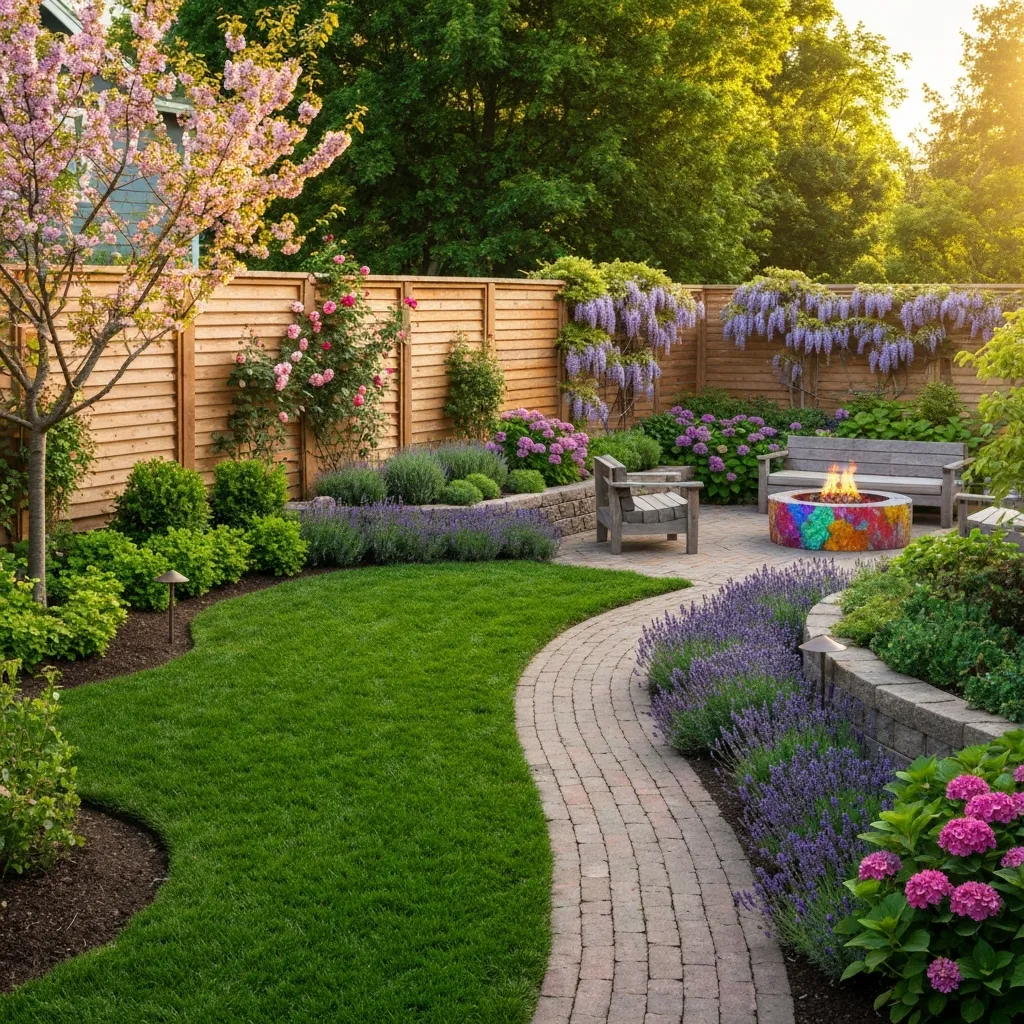
Work out the height before you look at a single plant
Privacy is geometry, not horticulture. The height a screen needs depends on where it sits between your eye and what you want gone: the closer to you, the shorter it can be.
It is a pair of similar triangles. Take your eye height, add the difference between eye and target, and scale that by how far along the sightline the screen stands:
Screen height = eye height + (target height − eye height) × (distance to screen ÷ distance to target)
Work one case. You are sitting on a terrace, eye at 4ft (1.2m). The problem is a neighbour's upstairs window, its centre 13ft (4m) up and 50ft (15m) away.
- Screen 3ft from your chair: 4 + (13 − 4) × (3 ÷ 50) = 4ft 7in. A standard 6ft fence panel does it with room spare.
- Screen at the boundary, 40ft away: 4 + (13 − 4) × (40 ÷ 50) = 11ft 3in. You need a hedge over 11ft, held there for good, for exactly the same result.
Same privacy: one needs under 5ft of material, the other 11ft 3in and fifteen years. Push a screen hard against the window and you fight its full height.
Two caveats. Standing changes it: at 5ft 6in eye height the near screen must be 5ft 9in, so a 6ft panel only just does. And a near screen works only from the seat it was set up for — step four feet sideways and you see straight past. A boundary hedge is worse value per foot but covers the whole garden.
Test it with a cane, not a catalogue
Sit where you actually sit. Have someone hold a bamboo cane at the planting spot and run a hand up it until they disappear. That is your number, usually lower than you feared.
The cost of overshooting
Every foot of screen buys shade you did not ask for. Midwinter noon sun sits about 15 degrees above the horizon at London's latitude, so a 10ft screen throws roughly 37ft of shadow behind it. At 40°N the sun reaches about 27 degrees and the same screen throws about 20ft. Height is often not yours to set: US gardeners face HOA covenants and municipal fence limits, England and Wales have High Hedges provisions for evergreen hedges over 2m, Scotland its own. Check first.
Plants that actually screen
| Plant | Foliage | Mature height × spread | Growth rate | USDA zones |
|---|---|---|---|---|
| Thuja plicata 'Green Giant' | Evergreen | 40–60ft × 12–20ft | Fast, 2–3ft/yr | 5–8 |
| × Cuprocyparis leylandii (syn. × Hesperotropsis) | Evergreen | 60–70ft+ × 12–20ft | Very fast, 3ft/yr | 6–10 |
| Taxus baccata | Evergreen | 30–50ft × 15–25ft; clips to any size | Slow, 8–12in/yr | 5–7 |
| Taxus × media 'Hicksii' | Evergreen | 10–20ft × 3–6ft | Slow, 8–12in/yr | 4–7 |
| Ilex aquifolium | Evergreen | 30–50ft × 12–25ft | Slow, 6–12in/yr | 6–9 |
| Osmanthus × burkwoodii | Evergreen | 8–12ft × 8–12ft | Slow to medium | 7–9 |
| Prunus lusitanica | Evergreen | 12–20ft × 12–15ft | Medium, 12in/yr | 7–9 |
| Prunus laurocerasus | Evergreen | 15–25ft × 15–25ft | Fast, 1–2ft/yr | 6–9 |
| Photinia × fraseri 'Red Robin' | Evergreen | 10–15ft × 8–12ft | Medium, 12–18in/yr | 7–9 |
| Elaeagnus × submacrophylla (syn. E. × ebbingei) | Evergreen | 8–12ft × 8–12ft | Fast, 1–2ft/yr | 7–10 |
| Thuja occidentalis 'Smaragd' | Evergreen | 12–15ft × 3–4ft | Medium, 9–12in/yr | 3–7 |
| Juniperus scopulorum 'Skyrocket' | Evergreen | 15–20ft × 2–3ft | Medium, 12in/yr | 4–9 |
| Cupressus sempervirens 'Stricta' | Evergreen | 20–40ft × 3–6ft | Medium to fast | 7–10 |
| Fargesia robusta 'Campbell' | Evergreen | 12–16ft × 4–6ft clump | Fast once established | 6–9 |
| Bambusa multiplex 'Alphonse Karr' | Evergreen | 15–25ft × 5–10ft clump | Fast | 8–11 |
| Carpinus betulus | Deciduous, winter cover | 40–70ft × 25–40ft; hedged 6–16ft × 2–4ft | Medium, 12–18in/yr | 4–8 |
| Fagus sylvatica | Deciduous, winter cover | 50–80ft × 40–60ft; hedged 6–16ft × 2–4ft | Medium, 12–18in/yr | 4–7 |
| Amelanchier lamarckii | Deciduous | 15–25ft × 15–20ft | Medium | 4–8 |
Clipped hornbeam and beech keep their dead brown leaves all winter, so they screen year-round without being evergreen — hornbeam on heavy or wet ground, beech only where drainage is free. Check your state or county noxious-weed list before ordering: several privets (Ligustrum sinense, L. lucidum, L. japonicum) are invasive across the US Southeast, Lonicera japonica across much of the country, and Prunus laurocerasus is a problem in the Pacific Northwest and in British woodland.
Bamboo: one rule
Buy clumping bamboo — Fargesia in cool climates, Bambusa in zone 8 and warmer — and nothing else. Running bamboos such as Phyllostachys, Sasa and Pleioblastus send rhizomes up many feet from the parent and will cross a boundary. If you must have one, fit an HDPE rhizome barrier about 2ft (60cm) deep, top few inches proud of the soil, seams overlapped and sealed, angled outward so rhizomes deflect upward where you can see them. It works only if somebody walks the line each year and cuts escapes. Most people stop by year four.
Spacing: the number that decides whether it works
Space plants at roughly 60 to 75 per cent of their intended maintained width. For a clipped formal hedge from whips — yew, hornbeam, beech, privet — that is 18 to 24in (45–60cm) in a single row. For unclipped shrubs such as Portuguese laurel held at 8ft wide, 5 to 6ft. Columnar conifers, 2 to 3ft. Thuja plicata 'Green Giant' left to grow, 8 to 12ft. Clumping bamboo, 3 to 4ft.
Halving those numbers closes the screen a year or two sooner, then ruins it. Crowded plants shade each other's inner and lower branches, that foliage dies, and you get a screen opaque at the top and open from knee to waist — precisely where a sightline sits. Root competition makes the run fragile in drought, and when one plant dies the gap is permanent: Thuja, Cupressus, × Cuprocyparis, Chamaecyparis and Juniperus will not break new growth from bare brown wood. Yew is the exception, which is why a neglected yew hedge can be cut hard and recovered and a Leyland cypress cannot.
How long you will actually wait
- Fast conifers from 3–4ft stock: almost nothing in year one while roots establish, then 2–3ft a year. Functional 8ft screen in years three to four.
- Medium evergreens — laurel, photinia, elaeagnus, hornbeam, privet: 8ft in four to six years.
- Slow dense evergreens — yew, holly, osmanthus: 8ft in eight to twelve years. Yew beats its reputation on good soil, but still a decade.
- Clumping bamboo: thin for two years, then near full height in one season. Screening by year three or four.
- Climber on trellis: annuals in one season; Trachelospermum jasminoides or Clematis armandii take three to four years to cover.
Instant hedging at 8–10ft exists and is expensive. Large transplanted stock also sits in check longer, so a hedge from 2ft plants often catches and passes one from 6ft plants inside five years. Buy it because you want it now, not because it ends up taller.
When a hedge is the wrong tool
A layered mixed border screens better than a wall for a fraction of the height. Small multi-stem trees — Amelanchier lamarckii, Crataegus monogyna, a birch — at 12 to 15ft centres, 6 to 8ft shrubs between, low planting in front. The eye stops at the near layer. You filter rather than block, which reads as private from a seat and keeps the garden light.
Trellis and a climber give height in a 12in bed where no hedge fits. Evergreen: Trachelospermum jasminoides, Clematis armandii, Hedera colchica 'Sulphur Heart', or Pyracantha trained flat. Deciduous: Lonicera periclymenum, Vitis coignetiae, Rosa 'Rambling Rector' where there is room. Self-clinging ivy on sound modern brickwork is largely cosmetic; on soft lime mortar it does real damage, so use wires on anything historic.
A berm buys height cheaply: a 3ft mound plus a 6ft shrub screens like a 9ft plant. The slopes must be gentle enough not to slump, so a 3ft berm needs a footprint near 15ft wide, and its crown dries out fast.
Sometimes a built screen wins outright: a bed under 2ft wide, a boundary you need fixed this season, dry shade under a mature tree, a rented garden, or root and foundation limits that rule trees out. Slatted and hit-and-miss screens beat solid panels twice over — wind passes through instead of curling over the top, so they blow down less and shelter further behind.
The four ways this goes wrong
- One species, one clone, one pathogen. Box blight (Calonectria pseudonaviculata) and box tree caterpillar (Cydalima perspectalis), cypress canker (Seiridium cardinale), cypress aphid (Cinara cupressi) and Entomosporium leaf spot on photinia all take out uniform hedges wholesale. Mix at least three species along any run over 30ft.
- Leyland cypress regret. It grows 3ft a year and does not stop at 6ft. It wants cutting twice a year for life, it will not reshoot from brown wood once it gets away, and it dries the soil either side. Plant Thuja plicata 'Green Giant' instead — nearly as fast, far more forgiving.
- Roots and boundaries. On shrinkable clay, water-demanding trees near shallow foundations are a subsidence risk and distance matters, so take local advice before planting anything large. Plant on your side of the line, not on it, and leave room to reach the far face: you have no automatic right to stand on a neighbour's land to clip it.
- Blocking your own light. Run the shadow numbers above. A 12ft evergreen wall on the sunny boundary of a small garden turns it into a damp green corridor, and the strip beneath never sees rain.
To see a 6ft screen beside the patio set against an 11ft hedge on the boundary before committing, MyGardenGPT will restyle a photo of your own garden with either — a cheaper way to change your mind than replanting.