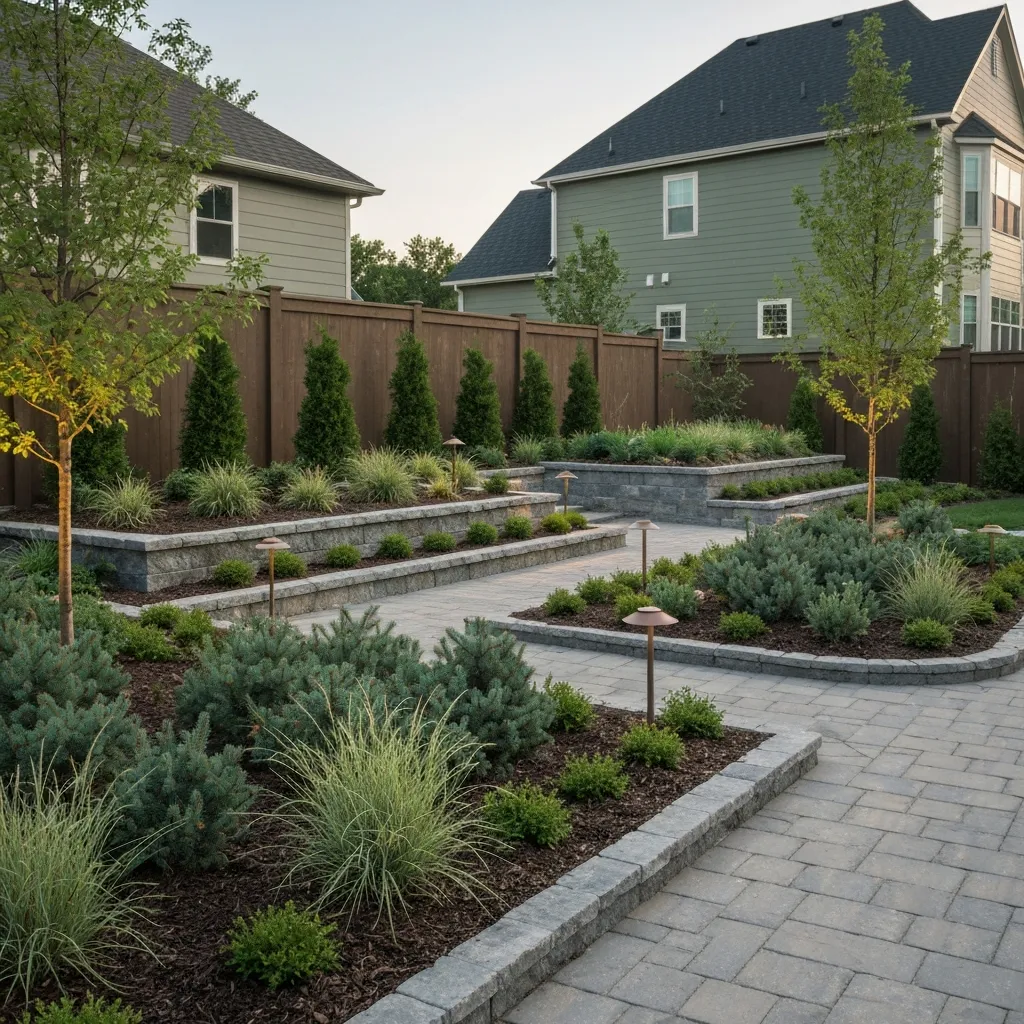
A rain garden is a shallow planted basin that catches roof and driveway runoff, holds it for a few hours, then lets it soak away. Built properly it turns a nuisance — the soggy strip under a downspout, the sheet of water crossing the drive — into the best-planted part of the garden. Built by eye, it becomes a muddy dip that either never fills or never empties. The difference is arithmetic and soil, in that order.
How big does the basin need to be?
Sizing starts from the contributing impervious area: the roof, drive or patio that actually drains to that spot. Not the whole roof — only the portion served by that one downspout. Measure its footprint on plan: a roof sheds the water falling on its plan area whatever its pitch.
You need three numbers:
- Contributing impervious area, in square feet.
- Design rainfall depth — the storm you want to capture in full. One inch is the usual domestic starting point.
- Runoff coefficient — about 0.95 for roof, asphalt and concrete, which shed almost everything that lands on them.
Area × rainfall depth in feet × coefficient gives the runoff volume. Divide it by your chosen ponding depth in feet for the basin's surface area.
A worked example
A 600 sq ft roof section feeds one downspout; the design storm is one inch. One inch is 0.0833 ft, so 600 × 0.0833 × 0.95 is about 47.5 cubic feet of runoff.
- 6 inches of ponding (0.5 ft): 47.5 ÷ 0.5 = 95 sq ft, an oval roughly 14 ft by 9 ft.
- 4 inches: 143 sq ft.
- 8 inches: 71 sq ft.
Shallower always means wider. The six-inch basin is about 16 per cent of the contributing area.
The rule-of-thumb ratios, honestly
Basin area is also quoted as a flat percentage of contributing area: commonly 20 to 30 per cent on sand, 30 to 35 on loam, 45 to 60 on clay. They are widely published but vary by region, and sit well above the 16 per cent this example produced. Percentage rules are meant to work without a calculator, so they assume a larger regional design storm, count the water held in the pore space of the soil mix as well as the ponding, and stay deliberately conservative.
Design with the volume method, sanity-check with the ratio, and where they disagree trust the larger. Better still, use the figures your state extension service or municipal stormwater office publishes for local soils.
The percolation test
Dig a hole to the proposed basin floor — 12 inches is a reasonable homeowner test — straight sided, flat bottomed, six to twelve inches across. Dig two or three in different parts of the footprint; soil changes over short distances.
Fill it and let it drain away completely. This pre-soak is the step most descriptions skip, and it matters: dry soil swallows the first fill and flatters the result. Refill to a measured depth (six inches is convenient), lay a straight edge across the hole and measure down to the water with a ruler. Measure again exactly an hour later. The drop in inches is your infiltration rate in inches per hour.
- One inch per hour or better — comfortable. Six inches of ponding clears in about six hours.
- 0.5 to 1 — workable. Six inches clears in six to twelve hours. Design towards the shallow end.
- 0.25 to 0.5 — marginal. Six inches takes up to a full day, leaving nothing in hand for a second storm. Reduce the ponding depth, widen the basin, or add an underdrain.
- Below 0.25 — a plain rain garden is the wrong answer. Look at a dry well, an underdrained bioretention cell, or another part of the garden.
One free check first: if water still stands there a day after heavy rain, the problem is the water table or a compacted pan, which planting will not fix.
Where it can go, and where it cannot
- At least 10 ft downslope of any foundation, further on clay or where there is a basement below grade. Some guidance recommends considerably more — check local code and err generously.
- Never on, or immediately downslope of, a septic tank, leach field or reserve area. Setbacks from wells and septic systems are set by local health code; 50 ft is commonly cited, but treat that as a prompt to check, not as permission.
- Keep the basin floor at least 2 ft above the seasonal high water table and above bedrock. A basin that reaches groundwater is a pond.
- Call 811 before you dig: free, a few working days, and buried utilities get marked. Private lines — irrigation, gas to a grill, lighting — are not on that map.
- Stay outside the dripline of mature trees; excavating there severs the roots they live on.
- Work with the fall of the land: the basin sits below its inlet, and the overflow needs somewhere safe to go, not the neighbour's garden.
Depth, profile, and the 24 to 48 hour rule
Ponding depth runs 4 to 8 inches, 6 a sound default; deeper reads as a pit and holds water longer. Side slopes no steeper than about 3:1 — three horizontal to one vertical — stay stable, plantable and safe underfoot.
Below the ponding zone, excavate and replace 18 to 24 inches of soil. A mix in the region of 50 to 60 per cent sharp sand, 20 to 30 per cent topsoil and 10 to 20 per cent compost is typical, though local bioretention specifications differ and yours should win. Mulch with 2 to 3 inches of shredded hardwood, never bark nuggets, which float and raft against the outlet.
Build a deliberate overflow: a low point in the downslope berm, set at ponding depth, armoured with cobble and aimed somewhere harmless. Storms larger than the design storm will arrive; better the water leaves where you chose.
The basin must be empty within 24 to 48 hours of the rain stopping, and the reason is mosquitoes. Most species need something on the order of a week of standing water to get from egg to adult, so a basin that clears in two days never becomes a breeding site. It also keeps the planting alive: wet-tolerant species tolerate saturation in bursts, not permanently.
What to plant, and where
Most rain garden articles give one plant list. A rain garden holds three growing conditions within a few feet of each other, and treating them as one is why so many are half dead by the second summer.
The wet centre is the floor, saturated after every storm and ordinary between them. The slope is the hardest place in the garden, alternately inundated and droughted. The rim is drier than the surrounding lawn, because the berm sheds water outwards.
| Zone | Plant | Why it sits there |
|---|---|---|
| Wet centre | Iris versicolor (blue flag iris) | A true wet-soil iris; early summer flower |
| Wet centre | Juncus effusus (soft rush) | Evergreen vertical; takes standing water |
| Wet centre | Carex stricta (tussock sedge) | Raised tussocks give the floor structure |
| Wet centre | Carex vulpinoidea (fox sedge) | Fast cover; holds soil at the inlet |
| Wet centre | Lobelia cardinalis (cardinal flower) | Scarlet spike; needs the moisture |
| Wet centre | Chelone glabra (white turtlehead) | Flowers late, when little else does |
| Wet centre | Hibiscus moscheutos (rose mallow) | Large late flowers; wants wet feet |
| Slope | Asclepias incarnata (swamp milkweed) | Lower slope, not the floor: moist, not inundated |
| Slope | Itea virginica (Virginia sweetspire) | Takes flooding and drying; scarlet autumn |
| Slope | Cornus sericea (red osier dogwood) | Binds the bank; red winter stems |
| Slope | Aronia melanocarpa (black chokeberry) | Wide moisture tolerance; fruit and colour |
| Slope | Eutrochium maculatum (joe-pye weed) | Height at the back; late nectar |
| Slope | Vernonia noveboracensis (New York ironweed) | Deep purple late; shrugs off the swing |
| Rim | Panicum virgatum (switchgrass) | Wet and dry alike; upright in winter |
| Rim | Schizachyrium scoparium (little bluestem) | Needs the drier rim; copper all winter |
| Rim | Sporobolus heterolepis (prairie dropseed) | Fine mounded texture; dislikes wet feet |
| Rim | Baptisia australis (blue false indigo) | Deep taproot; drought-proof once settled |
| Rim | Amsonia hubrichtii (threadleaf bluestar) | Gold autumn colour, driest edge |
These are North American natives spanning roughly zones 3 to 9 depending on species. Check regional suitability and your local invasive list, and substitute freely so long as you keep the zoning.
Making it read as a garden, not a hole in the lawn
A rain garden is dry most of the time. Design for the dry state and the wet days look after themselves.
- Give it a defined edge: a mown strip, a steel or stone edge, a cobble collar. A deliberate boundary is what separates a feature from subsidence.
- Plant in drifts of five to seven; one of everything reads as a plant collection. Repeat one grass or sedge round the rim to tie it together.
- Put the rock where it works: cobble at the inlet to break the incoming flow, and at the overflow. Scattered evenly it is decoration; concentrated it is engineering, and looks better for it.
- Level the floor so it ponds as an even bowl, and keep the shape simple, following the contour — a long oval or a soft kidney across the fall.
- Put the tallest planting on the far rim, so you look into the bowl.
- Choose for winter: red dogwood stems, copper little bluestem, seedheads and the tussocks of Carex stricta carry the feature through the months when nothing flowers and nothing floods.
Get the sizing and the percolation test right and the rest is ordinary planting. To see it before committing to the digging, MyGardenGPT restyles a photo of your own garden, and its $299 contractor-ready design package sets out the basin, levels and planting for whoever builds it.