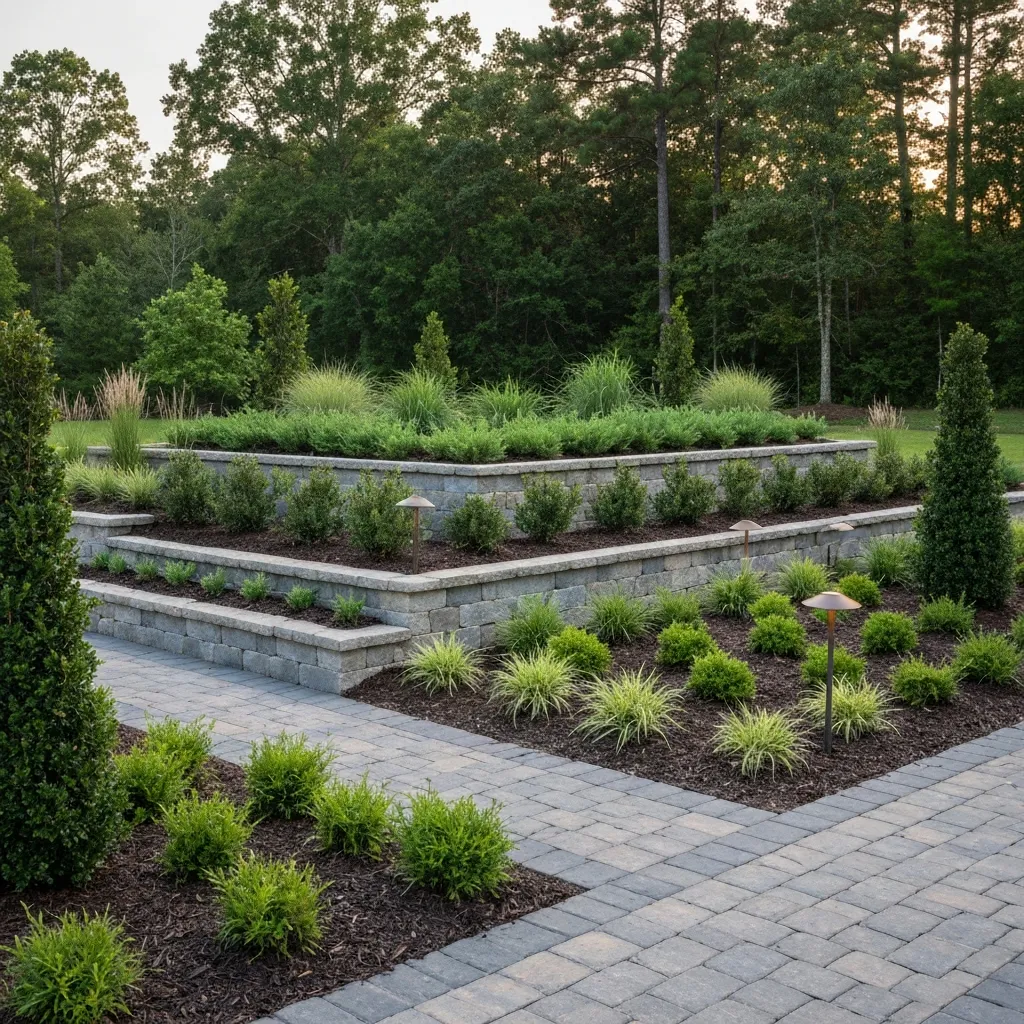
On a marsh-edge yard in the South Carolina Low Country, the best thing on the site was there before you were, and you may not touch it. The tidal marsh is the view, the wildlife and most of the weather. Everything you design sits behind it, on ground that takes salt on the wind, water from below and a hurricane every few years.
So this is a design problem of restraint. The failures repeat: a hedge at eye level between the porch and the creek; camellias set too near open water and burnt brown by the first tropical system; a mortared terrace on ground that moves. Avoid them by planning in bands, knowing where the state's jurisdiction starts, and matching every plant to its real exposure.
The conditions you are designing for
The Low Country runs from USDA zone 8a to 9a; the 2023 map revision moved much of the coast towards the warmer end. Cold is brief. Salt and summer set the real limits.
- Salt, twice over. Wind-borne aerosol salt scorches foliage year-round on the exposed side of a house. Storm surge is rarer and worse: it drives brackish water into the root zone and leaves sodium behind.
- Pluff mud and poor drainage. The upland behind the marsh is often thin sand over clay with a high water table, so a bed that drains in March stands in water in September. Pluff mud is anoxic silt that can turn sharply acidic as it dries. It is not free topsoil.
- Humidity. Summer nights barely cool. Air movement through a planting does more about fungal pressure than any spray programme.
- Live oak. A mature Quercus virginiana gives shade and storm resistance, and takes back a wide, shallow, greedy root plate. Raising the grade over those roots is a common way to kill one. Site the canopy so a lost limb misses the roof; loblolly pine (Pinus taeda) sheds limbs in storms.
Read the site as three bands
Walk from water to house and you may cross three environments in 60 feet. Treat them as three gardens.
The marsh and the critical area is not a planting zone. It is an existing community you survey, protect and design towards — not mown, not filled, not opened for a view. Where a bank is eroding, living-shoreline work with marsh species is an option, but it is permitted work: start with the regulator, not the nursery.
The transition, immediately landward of the critical line, is the most valuable ground you have. Here you hold the soil, hide the neighbour's bulkhead, and let the garden dissolve into the marsh instead of stopping at a fence. Plant it low, loose and unirrigated.
The upland carries the garden proper: courtyards, evergreen structure, shade planting under the oaks, and anything thin-leaved that would burn in the open.
What grows where
| Plant | Band | Design role |
|---|---|---|
| Spartina alterniflora (now often Sporobolus alterniflorus) | Marsh, flooded twice daily | Existing. Protect. The gold winter plane behind everything. |
| Juncus roemerianus | High marsh, at and below the line | Existing. Stiff and dark; reads black at dusk. |
| Spartina patens (Sporobolus pumilus) | Lowest transition | Combed meadow where flooding rules out shrubs. |
| Borrichia frutescens | Lowest transition | Grey-green sub-shrub; takes direct salt. |
| Iva frutescens | Transition | The natural shrub band. Work with it. |
| Baccharis halimifolia | Transition | Fast, tough; white seed haze in autumn. |
| Panicum virgatum | Transition to upland | Upright grass for wet feet and spray. |
| Muhlenbergia capillaris | Upper transition, drier upland | The pink October haze. Plant high, never wet. |
| Myrica cerifera (Morella cerifera) | Transition to upland | Workhorse evergreen screen; limb it up to see beneath. |
| Ilex vomitoria | Transition to upland | Evergreen structure, clipped or loose; takes salt and shade. |
| Sabal palmetto | Upper transition and upland | Vertical punctuation; storm-hardy, casts almost no shade. |
| Juniperus virginiana var. silicicola | Exposed upland flanks | Windbreak on the salt-facing side. |
| Yucca gloriosa | Exposed upland | Architectural, indifferent to spray. Keep off paths. |
| Quercus virginiana | Upland only, well back | Canopy and storm insurance. Never near the marsh. |
| Aspidistra elatior | Dry root-competition shade | Ground cover under oaks, where little else holds. |
| Hydrangea quercifolia | Sheltered upland shade | Bold leaf and autumn colour. Keep from salt wind. |
| Camellia sasanqua | Sheltered upland, walled or screened | The regional signature. Autumn flower, needs shelter. |
The critical line: survey before you draw
Tidal marsh in South Carolina is a state-regulated critical area, administered by the Office of Ocean and Coastal Resource Management (OCRM) across the eight coastal counties. The boundary is the critical line, broadly the landward extent of the marsh, set on the ground by an OCRM field representative rather than by your plat.
- Seaward of the line, assume everything needs a permit: docks, walkways, bulkheads, revetments, fill, ditching, vegetation removal. Walkway width, pierhead area and covering are all constrained, and the figures depend on permit class and water body, so treat a dock as an early design input.
- Landward of the line, buffers are local and they vary. Some jurisdictions require none; others require a vegetated buffer of several tens of feet in which clearing and hard surfaces are restricted. Beaufort County has long applied one. Rules differ by county and change over time, so confirm the current figure with your county zoning office.
Get the line flagged before you draw. Determinations are re-flagged periodically and marsh migrates landward as sea level rises, so assume the line may move towards you.
Framing the water
The marsh is a low, horizontal, changing plane. The job is to frame it, not fill it. From the porch and the main living room, keep the band roughly three to six feet above ground clear across the primary sightline. What stands there should be transparent — grass heads, limbed-up trunks — or pushed to the flanks.
That is also how you screen a neighbour. Not at the marsh edge, where it costs everyone the view, but close to the house and to the sides. A ten-foot evergreen mass twenty feet from the porch removes a neighbouring roof and reads as a frame; the same mass at the water removes the marsh.
Design for both tides. At high water the marsh is a sheet of light; at low water it is mud, oyster rakes and creek channels. A planting that leans on flowers looks thin half of every day, so carry it on evergreen mass, trunk lines and grass texture, with muhly against gold cordgrass in October as a bonus.
Boardwalks, decks and materials that last
Cross wet ground on an elevated boardwalk on piles, not on fill: filling is poor hydrology and, near the line, a permitting problem. Keep the structure open beneath so surge passes through.
- Metal. Type 316 stainless for exposed fixings and cable; hot-dip galvanised steel to the relevant ASTM standards where stainless is unaffordable. Electro-galvanised hardware fails here, and copper-based treated timber hastens it.
- Timber. Ground-contact-rated treated softwood for structure; durable hardwood, thermally modified timber or good composite on top.
- Railings. Stainless cable or a slim horizontal rail keeps the view. A chunky balustrade cuts the marsh off at exactly the wrong height.
- Paving. Shell paths and tabby are regional, permeable and forgiving. Brick or stone on a sand bed can be relifted after settlement; mortared paving cracks when the ground moves, which here it will.
The numbers
- Setback. Treat the flagged line plus any county buffer as a hard boundary for terraces, pools and beds. Where no buffer applies, 20 to 30 feet of unmown transition planting is still worth leaving.
- Planting depth. Set the root flare 2 to 3 inches above finished grade in heavy or wet ground and mound soil to meet it. Dig two to three times the width of the root ball, no deeper. Where the water table is high, raise whole borders 6 to 12 inches in a sandy loam.
- Mulch. 2 to 3 inches of pine straw, held 3 to 4 inches clear of stems. Pine straw stays on slopes; shredded bark floats away in a surge.
- Spacing. Muhlenbergia capillaris 3 to 4 feet apart; dwarf Ilex vomitoria 3 feet; Myrica cerifera 8 feet for a solid screen; Sabal palmetto 10 to 15 feet in a group; Quercus virginiana at least 40 feet from a building and from each other, since mature spread often reaches 60 to 80 feet.
- Timing. Woody plants October to March, so roots establish over a mild winter. Warm-season grasses in spring once the soil warms. Palms are the exception: they move best in the heat, roughly late spring to late summer.
- Water. A common rule of thumb is a gallon per inch of trunk caliper, two or three times a week through the first summer. Test any shallow well for chloride first.
- After a surge. Where drainage allows, flush affected beds with fresh water to leach sodium out of the root zone.
Humidity and the maintenance year
Fungal pressure is a design variable, not just a spraying task. Space plants for air movement rather than instant effect, avoid tight shearing that traps damp inside a shrub, and water at the base in the morning rather than overhead at night. Prune sheltered evergreens after they flower, and give salt-sensitive planting a real windbreak.
A marsh-edge garden that works looks inevitable: a clipped evergreen frame near the house, a limbed-up canopy overhead, grasses running to a boundary you cannot quite find, and nothing in the way of the water. Most of the skill is deciding what to leave out. MyGardenGPT will restyle a photograph of your own yard, if it helps to test where a screen goes before you build it.