Backyard Drainage Solutions: Find the Right Fix
Compare backyard drainage solutions, costs and limits. Trace runoff, check grading and easements, and choose a French drain, swale or rain garden for your yard.
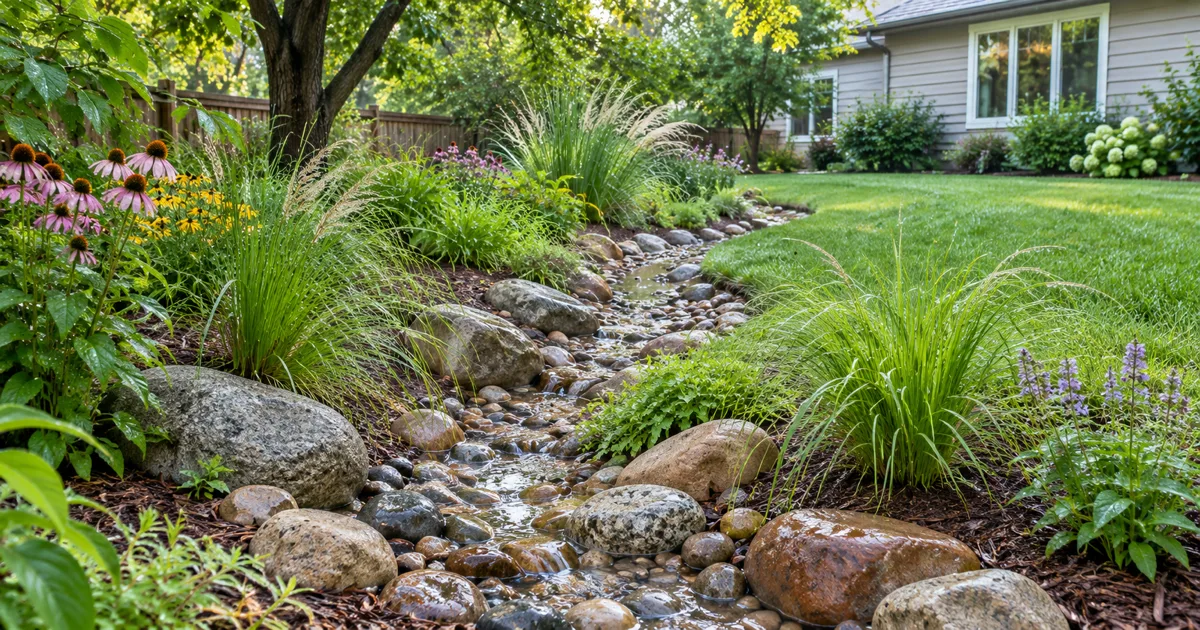
After each rain, a stream crosses your back fence and leaves the lawn too wet to mow. Before choosing backyard drainage solutions, trace where that water starts and where it can safely go. Check the grade and any drainage easement, then choose a system with a workable outlet or enough suitable soil to absorb the water.
In this article
Where is the water coming from?
Watch a storm from a safe, sheltered spot. Record where water first appears, its route, and what happens after rain stops. Photograph the house and fence together, then overflowing gutters, pipe outlets, or erosion. Stay out of moving water.
Separate your yard drainage problems into three possible sources. Your own roof, paving, and grading may concentrate water beside the house. Runoff may enter from a neighboring lot or street. Or a pipe or road culvert may discharge into an established drainage route through your property.
If the wet strip begins directly below a downspout, investigate roof drainage first. If a stream arrives through the fence before your lawn becomes saturated, follow its upstream route visually and ask about the drainage system serving it. Digging where water finally pools can miss the cause.
Sketch those routes alongside the house, patios, trees, and property lines. Use the same drawing when requesting help. Our landscape design guide for beginners explains how to organize a site sketch before choosing new features. If you just moved into a new house, our guide on where to start landscaping a new house explains why drainage comes first.
Is the grade wrong?
Water flowing toward the foundation deserves attention even if it disappears soon after the storm. A puddle draining quickly doesn't establish that the grade is correct. Check grading around house corners and patio edges, where runoff may turn toward the building.
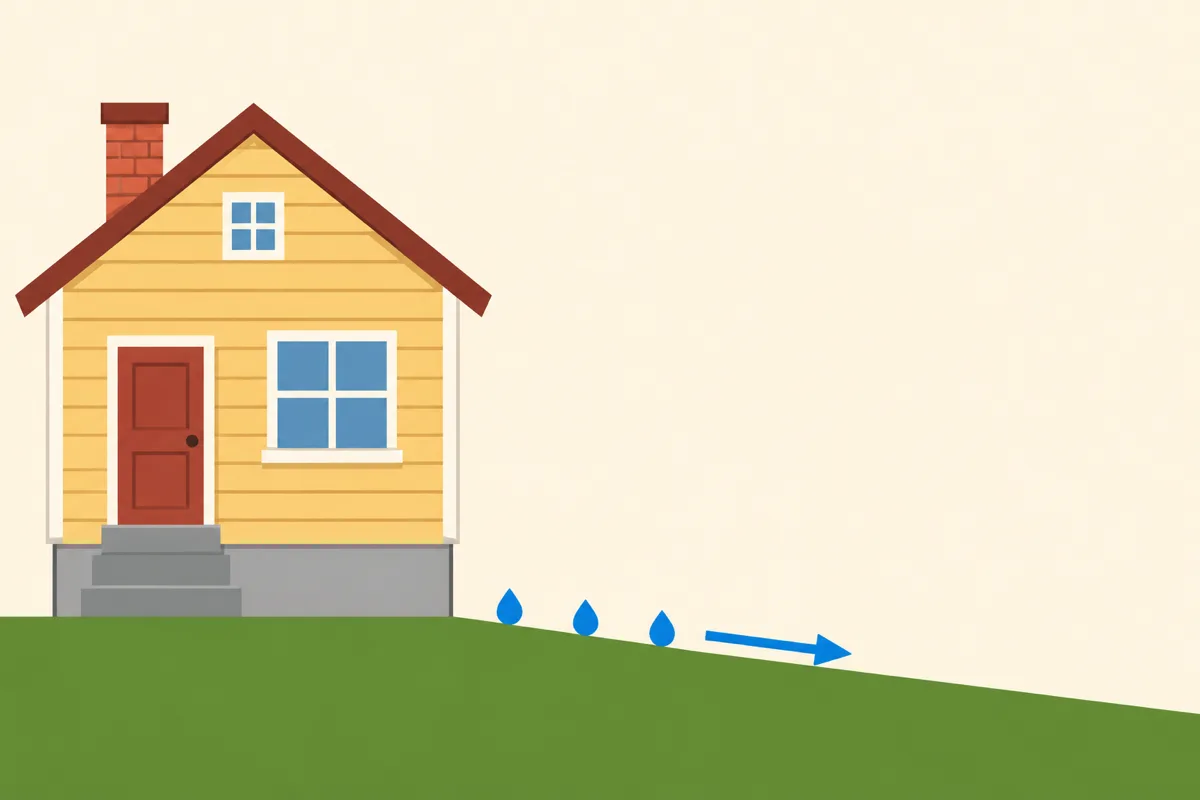
IRC Section R401.3 gives a common benchmark: soil grade should fall at least 6 inches within the first 10 feet away from the foundation. Where lot lines or other barriers prevent that fall, the model code calls for drains or swales that carry water away. Your locally adopted code and amendments control; this isn't a universal instruction to pile soil against the wall.
Have proposed elevations checked before adding fill. A correction must preserve required clearances at siding, openings, and the foundation while providing somewhere for runoff to go. A narrow side yard may need a designed drainage route because there isn't enough room to obtain the required fall.
What should you document on a new build?
Photograph water against the house, record dates and video, and request the approved grading plan and a site inspection. Send the repair request in writing before the applicable warranty deadline, using the claim process in your documents. Keep delivery records and the builder's responses. A verbal assurance that the water drains quickly gives you little to refer back to.
Warranty coverage and deadlines vary. Check whether drainage is covered and which deadline applies. Request the correction and its elevations in writing.
New turf can hide compacted subsoil and unsuitable fill. A thin layer of topsoil won't necessarily restore infiltration through the material beneath it. If inspection reveals rubble under the lawn, have the builder explain how that fill meets the site specification. Address the ground conditions before paying for replacement sod or planning the rest of your new-construction landscaping.
Do you have a drainage easement?
A drainage easement grants specified rights over part of a property, often to convey water or access drainage infrastructure. You may own the grass above it while still having restrictions on what you can build there.
Before buying a property or installing a fence, shed, or deck, check the recorded plat, survey, and title policy exceptions. Ask the title company for copies of referenced easement documents. Have a surveyor locate unclear boundaries and ask the easement holder what work requires written approval. The recorded terms matter more than how the yard is currently being used.
A fence across a ditch can trap debris, obstruct flow, and send water around its ends. Local rules vary: some authorities allow approved fences that preserve drainage and access; others prohibit encroachments. A shed or deck can also block the route or maintenance equipment. Obtain approval before construction, even if the HOA has already agreed.
You may face removal costs or a claim if your work obstructs drainage and causes damage. Confirm the actual restrictions and responsibilities rather than assuming the city will maintain everything within an easement.
Which backyard drainage solutions fit: French drain, swale or rain garden?
Decide whether you need to move water along a safe route or hold it temporarily so it can soak into suitable soil. Conveyance needs an outlet. Infiltration needs adequate soil absorption, storage, and overflow space. Some yards need both.
Start with roof runoff when the source is yours
Check existing gutters for blockage or overflow before excavating the lawn. For aboveground downspout discharge, DOE's Building America guidance uses at least 5 feet from the foundation onto ground sloping away. Its guidance places underground catchment systems at least 10 feet away. Local requirements and site conditions may require more distance.
Use solid pipe to carry roof water away without releasing it along the foundation. An extension won't help if its end sits in a hollow that drains back toward the house. Keep the discharge on an approved route that doesn't create erosion, a walking hazard, or a problem next door.
Choose a French drain for water entering the soil
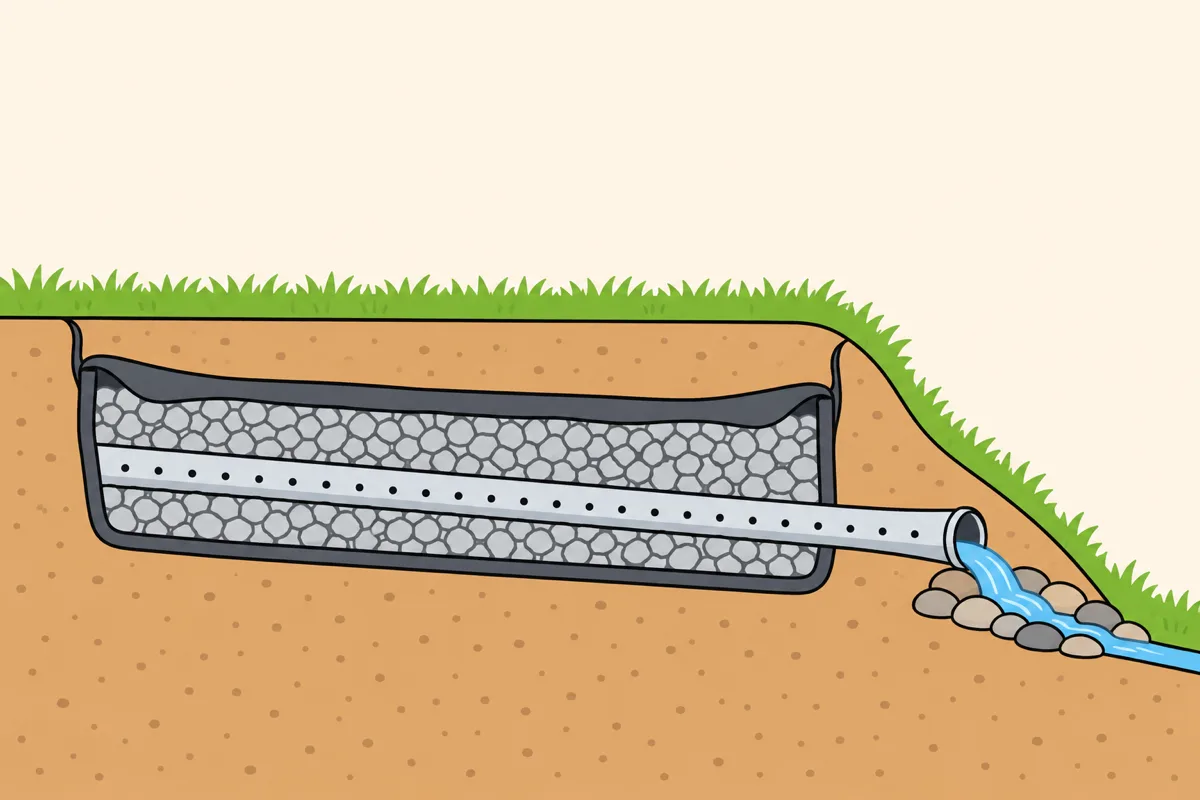
A conventional French drain collects water through a gravel-filled trench and perforated pipe. It can intercept seepage or drain a persistently soggy strip. Comparing a French drain vs swale starts with the water's behavior: buried collection suits water moving through soil; an open swale provides a visible route for surface runoff.
Specify washed drainage gravel, perforated pipe, and geotextile selected for the soil and installation detail. Ask to see the materials and pipe elevations before the trench closes. Never accept tires, demolition waste, or miscellaneous junk as substitutes for specified drainage aggregate. Photograph the installation while it is visible.
For gravity drainage, establish continuous fall to a lower, approved outlet. NDS recommends a minimum 1% slope for its EZflow system; follow your system's instructions and site design. At a daylight outlet, the pipe emerges onto suitable lower ground where water can flow safely away.
A flat-looking lawn doesn't automatically rule out a drain, but a buried pipe with no usable outlet won't provide reliable gravity drainage. A dry well is a possible destination only after infiltration testing and sizing. Leave large storm flows to a system designed for their volume.
Use a swale or dry creek bed for surface flow
A swale is a shallow channel that guides runoff. Grass or other suitable vegetation protects the soil; rock lining can protect a channel where the design calls for it. Leaving a bare trench in moving water invites erosion. A dry creek bed is a rock-lined drainage feature, and its shape still needs to match the flow.
Massachusetts homeowner guidance describes vegetated swales with a gentle longitudinal slope of about 1% to 3% and a flat base 2 to 10 feet wide. Those dimensions illustrate the space a swale can require. They don't size a channel receiving a road culvert. Its contributing area, storm flow, soil, and outlet determine the required section and erosion protection.
For a rock-lined detail, use the specified filter fabric beneath drainage rock to separate it from soil. Plant suitable margins without obstructing the flow path, and keep sediment from filling the stone. A fast stream cutting deeper after every storm needs engineering review before you add decorative river rock.
Build a rain garden where water can soak in
A rain garden is a shallow planted basin that temporarily collects runoff. A low, fairly flat part of the yard can work if its soil drains adequately. A permanently waterlogged patch or high water table can make it unsuitable. Native plants won't make an undersized basin accept unlimited runoff.
University of Minnesota Extension recommends at least 10 feet between a rain garden and buildings. Local guidance, soil, slope, or foundation conditions may require more. Slab foundations also need protection from concentrated water; having no basement doesn't establish a safe infiltration location.
Before digging, arrange utility marking through 811 and locate private lines that the service may not mark. Keep excavation away from established tree roots and septic facilities.
- Follow your local extension service's infiltration test. Minnesota's screening test uses a water-filled, 10-inch-deep hole that should empty within 48 hours. If it fails, reconsider the site or obtain a designed alternative.
- Size the basin for the area draining into it and local rainfall. Establish an inlet and a safe overflow route before excavation.
- Remove sod and excavate a shallow basin with a level bottom and gently sloping sides. Regrade the approach so runoff enters it. Preserve the soil's ability to absorb water; don't create an impermeable pond liner.
- Protect the inlet and overflow against erosion, using rock where specified. Use fabric only where the rock or drainage detail requires separation, rather than blanketing the planted basin. Plant regionally native species suited to alternating wet and dry conditions.
Choose plants for the wetter bottom and drier edges separately. Use our native plant landscape design guide after establishing drainage suitability.
Consider a dry well only after testing the soil
A dry well stores runoff underground. It can help with standing water in yard depressions if surrounding soil absorbs the collected water. It doesn't create an outlet through impermeable ground. NDS advises checking percolation, runoff volume, local groundwater separation requirements, and overflow. Poorly draining clay or a high water table may rule it out. Include access for inspection and cleaning in the proposal.
How much does yard drainage cost?
These approximate US planning ranges were checked in November 2026. HomeGuide supplies the extension, shallow-drain, swale, regrading, and rain-garden figures; Angi supplies the professional dry-well range. They describe different scopes, so don't add them together as a package or treat them as local bids.
| Work | Approximate cost | Budget limit |
|---|---|---|
| Simple downspout extension | $5 to $25 | Basic extension; buried piping and excavation are separate. |
| Shallow yard French drain | $10 to $30 per linear foot | Doesn't represent deep foundation excavation or basement work. |
| Drainage swale | $5 to $15 per linear foot | Engineered channels and substantial rock lining need separate pricing. |
| Yard regrading | $500 to $5,000 | Area, access, soil movement, and lawn restoration affect the total. |
| Rain garden | $500 to $3,000 | Size, excavation, soil work, and planting scope vary. |
| Professionally installed dry well | $1,334 to $5,139 | Confirm testing, permits, connections, and restoration in your quote. |
Request several written estimates against the same drawing. Each should identify the collection area, elevations, outlet or infiltration destination, materials, approvals, spoil disposal, and finished-yard restoration. Ask who checks performance and what the warranty covers. A cheaper trench is poor value if the proposal never identifies where its water goes.
If the project involves broader yard planning, review landscape designer costs separately from engineering and construction. If a wall is proposed, include its drainage and structural requirements when comparing retaining wall costs.
When should you call a civil engineer or the city?
Contact public works, the road authority, or your county drain commissioner where that office exists if a public pipe or road culvert appears involved. Send storm video, the location, and erosion photos. Ask who maintains it, whether it has an easement, and how to request inspection. Keep the request number.
The public body may maintain its pipe without being responsible for all drainage on your lot. A driveway culvert may be privately maintained even beside a public road. Get the maintenance boundary confirmed before commissioning work or assuming you'll be reimbursed.
Hire a licensed civil engineer when runoff crosses several properties, a channel is eroding rapidly, or proposed storage could affect buildings or downstream land. Ask for surveyed elevations, flow and storage calculations, an outlet design, and an overflow route. Basin and culvert work needs a site-specific scope and quote. A planting layout can't establish drainage capacity.
In common usage, a dry detention basin temporarily holds stormwater and releases it, while a retention pond keeps a permanent pool. Terminology varies: some agencies also use “wet detention” for permanent-pool systems. Ask how the proposed facility empties and what water level should remain. Neither name makes unexpected water against your foundation acceptable.
What should you avoid?
Don't build a berm or redirect a pipe toward your neighbor to get water out of your own yard. Confirm local discharge rules and downstream effects before changing the route. A fence, wall, or raised bed can obstruct drainage just as effectively as deliberate earthwork.
Avoid choosing a drain by price before checking its destination, closing a trench before inspecting materials, or treating the foundation's wetting as harmless because the lawn dries later. Recheck the finished work during rain, including its inlet, outlet, and overflow. Photograph any new erosion or water flowing back toward the house and request correction.
FAQ
Can I fix drainage myself?
You can often address a simple downspout discharge problem or build a small rain garden after checking soil suitability, utility locations, and local requirements. Get professional help for foundation excavation, shared drainage, public infrastructure, steep slopes, or uncertain outlets. Start today by documenting the water's route and checking your property records.
Does water near the foundation matter if it drains quickly?
Yes. Repeatedly directing runoff against the building can saturate foundation soils and contribute to moisture problems. Record how water reaches the wall and have the grade and roof drainage checked. A short puddle duration alone doesn't show that the site drains safely.
Who pays when water comes from a public pipe or road culvert?
Responsibility depends on ownership, easement terms, local rules, and the cause of the problem. Ask the maintaining authority to inspect and identify its obligations in writing. Maintenance responsibility and liability for damage are separate questions; seek local legal advice if costs or responsibility are disputed.
Will a French drain work on flat land?
Possibly, if surveyed elevations allow the pipe to fall toward a lower, approved outlet, or a designed infiltration destination can accept its flow. A flat lot with neither has no reliable gravity-drainage solution simply because you bury perforated pipe. Test the destination before buying the drain.
How far from the house should a rain garden be?
University extension guidance commonly starts at least 10 feet away. Local rules and site conditions may require more. Keep stored water and overflow away from all foundations, including slabs, and have difficult sites assessed before excavating.