How Far Apart to Plant Trees and Privacy Hedges
Learn how far apart to plant trees and privacy hedges, choose plants that fit your yard, avoid utility lines, and give new roots the water and space they need.
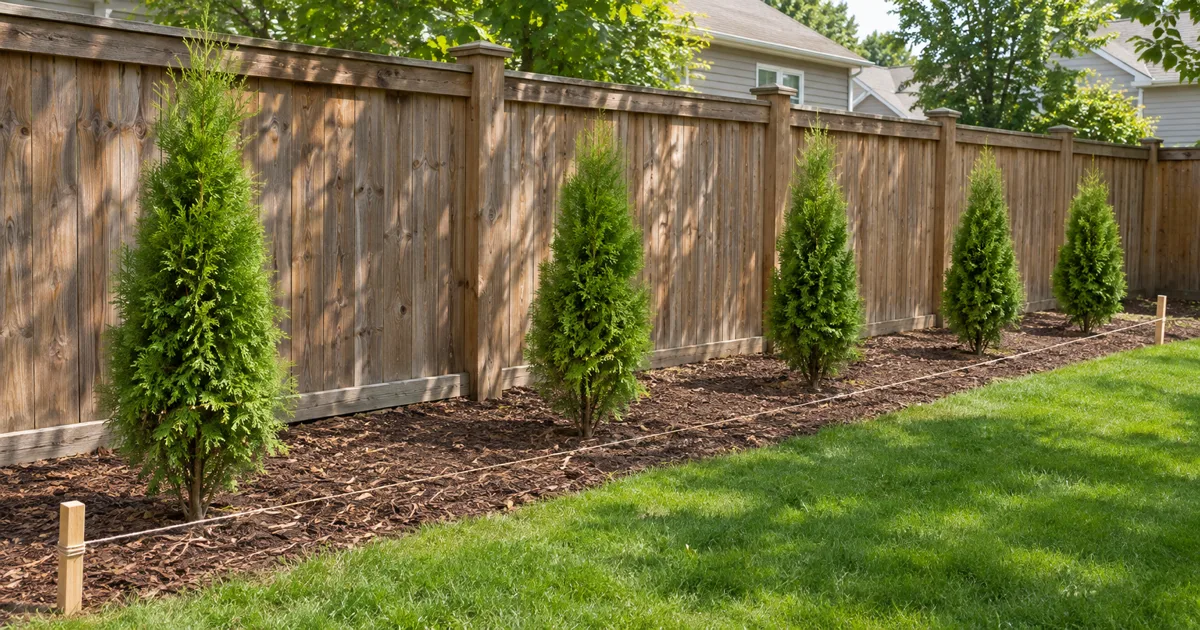
You stand in the nursery lot with a cart of young cypresses, picturing a green wall along your bare fence. Before buying, work out how far apart to plant trees using their mature width and the job you want them to do. A screen needs some overlap; a specimen needs room to develop its crown. Roughly half the mature width can suit some hedges, but species-specific guidance takes priority. Measure between trunks, never between pots.
How far apart to plant trees and privacy hedges?
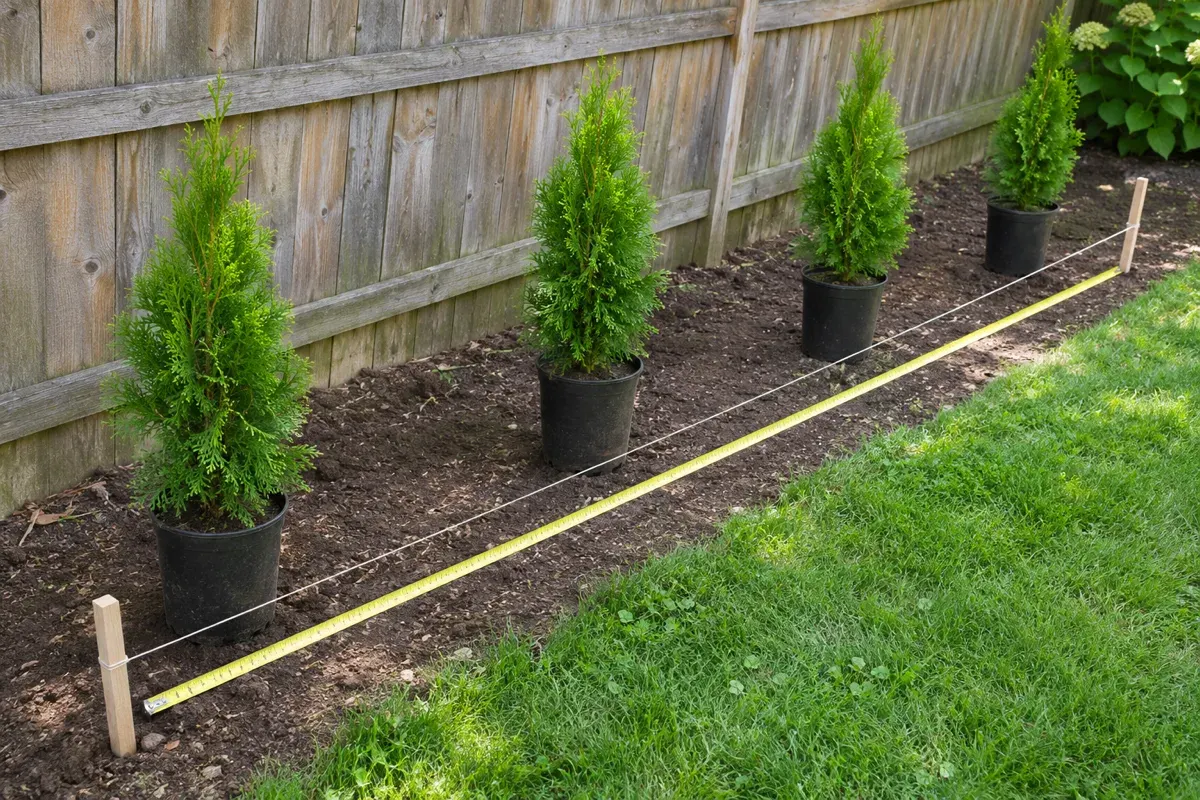
Read the cultivar name and mature dimensions on the tag. Then check a regional extension guide: a plant's advertised size may describe a particular age or growing region. Draw its full width on your plan before deciding how much overlap your privacy hedge needs.
A half-width spacing is a rough starting point for comparing hedge layouts, not a rule for every evergreen. Iowa State Extension distinguishes sheared hedges from informal ones, which need spacing based on mature size. For separate crowns, allow the combined mature radii: two hypothetical trees that each grow 20 feet wide need about 20 feet between trunks just for their crowns to meet.
Italian cypress spacing needs a different answer from spacing for a broad conifer. University of Florida guidance describes a dense Italian cypress screen at 3 feet apart. Clemson recommends at least 12–15 feet between Leyland cypresses to improve air circulation. Those numbers belong to different trees and conditions.
You have two workable approaches. Buy fewer plants at their long-term spacing if your budget is tight and you can wait. Larger nursery stock gives more initial coverage, with greater purchase and establishment demands. Alternatively, plant a temporary denser screen only if you're willing to remove plants later.
For that second approach, mark the temporary trees on the drawing and budget for removal. As a planning example, schedule thinning reviews during years three through eight; growth determines the actual date. Don't wait until lower branches have died from shading. The Lakeshore Counties tree-planting guide warns that close screen plantings need thinning to give the remaining trees room. That trade-off is harder with evergreens that won't regrow from bare old wood.
If you plant temporary trees, mark which ones you'll remove before you buy them.
Why does a hedge of one species fail all at once?
A matching row shares vulnerabilities. The same pest can find suitable hosts along its entire length, and the same wet soil can damage every plant. A single death also leaves an obvious opening at the exact height where you wanted privacy.
Mix two or three suitable species if the bed has room. Maryland Extension recommends mixed screens for resilience; different cultivars of the same species don't provide the same diversity. Staggering plants can soften gaps, although it takes more depth than a straight row. Start with native plants suited to your soil and light. Mixing plants doesn't rescue a poorly drained site.
Crowding compounds stress. Clemson identifies drought and wounds as factors favoring Leyland cankers, poor drainage as a driver of Phytophthora root rot, and prolonged leaf wetness with reduced airflow as conditions favoring needle blight. Extra spacing helps air circulation; it doesn't drain saturated soil or cure an infected tree.
Water at soil level and investigate isolated browning, branch dieback, or resin on stems before replacing a dead plant with the same species. These signs need diagnosis; browning alone doesn't identify a disease.
A uniform hedge can still fit a formal yard. Accept the visible-gap risk and keep the cultivar name for replacements. Plan regular checks through the first five years, including irrigation checks during dry weather. Five years is a maintenance planning window, not a promise that watering or disease monitoring ends then.
Which privacy trees fit a narrow strip?
Measure the usable bed between the fence, path, house, and access route. A narrow crown can still become a very tall tree. These extension-listed dimensions are planning ranges, not guaranteed maximums.
| Plant | Mature height × width | What limits its use? |
|---|---|---|
| ‘Emerald Green’ arborvitae, also called ‘Smaragd’ | 10–15 × 3–4 feet | Needs suitable moisture and light; deer can browse it. |
| ‘DeGroot's Spire’ arborvitae | 15–30 × 4–5 feet | Slow growth; dry, exposed sites and snow or ice can cause problems. |
| Italian cypress | 40–70 × 3–6 feet | Needs sun and drainage; its height can overwhelm a residential setting. |
| ‘Skyrocket’ juniper | 12–20 × 2–3 feet | Maryland's screening guide lists it for full sun; verify local performance. |
| ‘Sky Pencil’ holly | 4–10 × 1–3 feet | Slow-growing; alkaline soil, drought, and hot, humid conditions can limit performance. |
The arborvitae spacing question starts with the cultivar. ‘Green Giant’ reaches 40–60 feet tall and 12–18 feet wide in NC State's profile. Maryland lists Leyland cypress at 60–70 feet tall and 15–25 feet wide. Neither belongs in a narrow bed simply because the nursery plants fit today. Read about planting Green Giants before choosing that scale.
Check the USDA Plant Hardiness Map against the exact cultivar, then check sun, drainage, and exposure separately. The map describes average annual extreme minimum winter temperature; it doesn't establish heat tolerance or soil suitability. Confirm HOA requirements, local planting rules, and overhead utility clearance before ordering.
For a new-construction yard, put the planting line and mature widths on the ground first. You may discover that an apparently empty strip is also your only route for a mower or future repairs.
Should you plant bamboo as a hedge?
For a typical boundary planting, I'd choose another screen unless you're prepared for continuing containment work. A bamboo privacy hedge must be identified as running or clumping before purchase. Running types spread through underground stems called rhizomes and can cross into adjacent yards. Clumping types expand more slowly, but still need space and a suitable climate.
A barrier is a maintenance system. Maryland Extension describes a 30–36-inch-wide barrier roll installed vertically, leaving 6–8 inches above ground. Those are material width and exposed height, not a recommendation to bury the whole roll. Use purpose-made rhizome-barrier material, secure seams, and inspect for runners crossing the lip. Check utilities before trenching.
Containers aren't dependable long-term containment for running bamboo. Maryland warns that rhizomes can escape drainage holes and eventually break container walls. Removal can take years of repeated control, and a barrier doesn't kill rhizomes already outside it. Check state invasive-plant restrictions and municipal rules before buying. Keep growth within your lot and arrange any work across the boundary with your neighbor's permission.
A bamboo barrier still needs inspection and removal of rhizomes that cross it.
How close to a house, fence, or pipe is too close?
Use mature crown radius as an initial building setback, then check the species and site. Maryland Extension gives the example of a tree with a 40-foot mature width planted 20 feet from the foundation. Washington State Extension advises at least 20 feet for strong-wooded large shade trees, with greater distances for some others. These are planning guides, not guarantees against root or branch conflicts.
Trees too close to house walls can leave inadequate room for branches and maintenance. A narrow crown also doesn't mean a narrow root system. Keep large trees clear of sidewalks and retaining walls, and keep woody screens away from septic drainfields. UF/IFAS warns that roots can extend well beyond the canopy. Have the septic layout reviewed before choosing a planting distance.
Beside a fence, allow the plant's mature radius plus room to maintain both the foliage and fence from your property. Account for easements. A tree that fits within the boundary can still obstruct access to a utility or overwhelm a neighboring space.
On a steep slope above another house, arrange an ISA Certified Arborist's assessment, preferably with Tree Risk Assessment Qualification, before removing trees or excavating for new ones. Slope, root condition, altered drainage, and nearby targets all affect the assessment. A leaning tree isn't automatically unsafe, and a straight one isn't automatically safe. A moving retaining wall or unstable slope also needs an appropriately qualified engineer.
Finish grading and resolve backyard drainage before planting. For the order of work, see where to start landscaping a new house. Where trees, utilities, and structures compete for space, compare landscape designer costs before ordering plants.
Do you need to call 811 before you plant?
Yes. Call 811 before planting whenever you'll dig, including shallow garden work. The free request notifies participating utility owners to mark their buried facilities. Allow the state's required notice period, commonly two or three business days, and confirm every notified utility has responded. Use call811.com to find your state's instructions before committing to a delivery date.
You have the shrubs ready, the locate ticket says clear, and your shovel meets a pipe just below the grass. A clear response doesn't establish that every buried line has been found. The distinction is ownership and participation, not whether a line lies inside your yard.
Utility-owned gas, electric, water, and telecom facilities are generally covered through participating owners. Private irrigation, septic components, sewer laterals, and electrical lines to sheds, pumps, or yard lights may need separate locating. The ownership boundary can be at a meter or right-of-way; ask which portions each response covers.
Ask the builder and installers for as-built plans showing what was actually installed. Check for valve boxes, pump equipment, and services to outbuildings. Then hire a private locator where needed; your state 811 center may provide a directory. Private locating usually carries a separate fee. Tell the locator about plastic pipes and ask what the proposed method can detect.
An existing, accessible tracer wire can help locating equipment follow a nonmetallic pipe. It won't reveal an unrelated untraced pipe. For newly installed private services, Gopher State One Call recommends maps and tracer wire; have the installer specify it for future locating.
Outline the dig area as your center instructs. Preserve utility marks, use the state's required careful excavation method near them, and hand-dig where directed. Marks show approximate horizontal location, not a safe digging depth. A hand shovel can still damage a line. Stop at an unexpected pipe and identify it before continuing. Document questionable shallow builder-installed lines and ask the builder to review them under the applicable warranty; appearance alone doesn't prove a defect.
Confirm private lines separately, even when every utility on your 811 ticket has responded.
Before buying, use this short checklist:
- Mark the planting line, mature widths, access routes, and overhead wires.
- Finish grading and identify where runoff goes.
- Complete utility responses and arrange private-line locating.
- Choose who will water, check soil moisture, and watch for declining plants.
What do you do about an existing big tree?
Keep a healthy shade tree in the plan unless there's a specific reason to remove it. The Department of Energy explains that shade reduces solar heat gain and can lower cooling costs. The benefit depends on placement, canopy, climate, and the house; don't attach a promised dollar saving to a tree you haven't assessed.
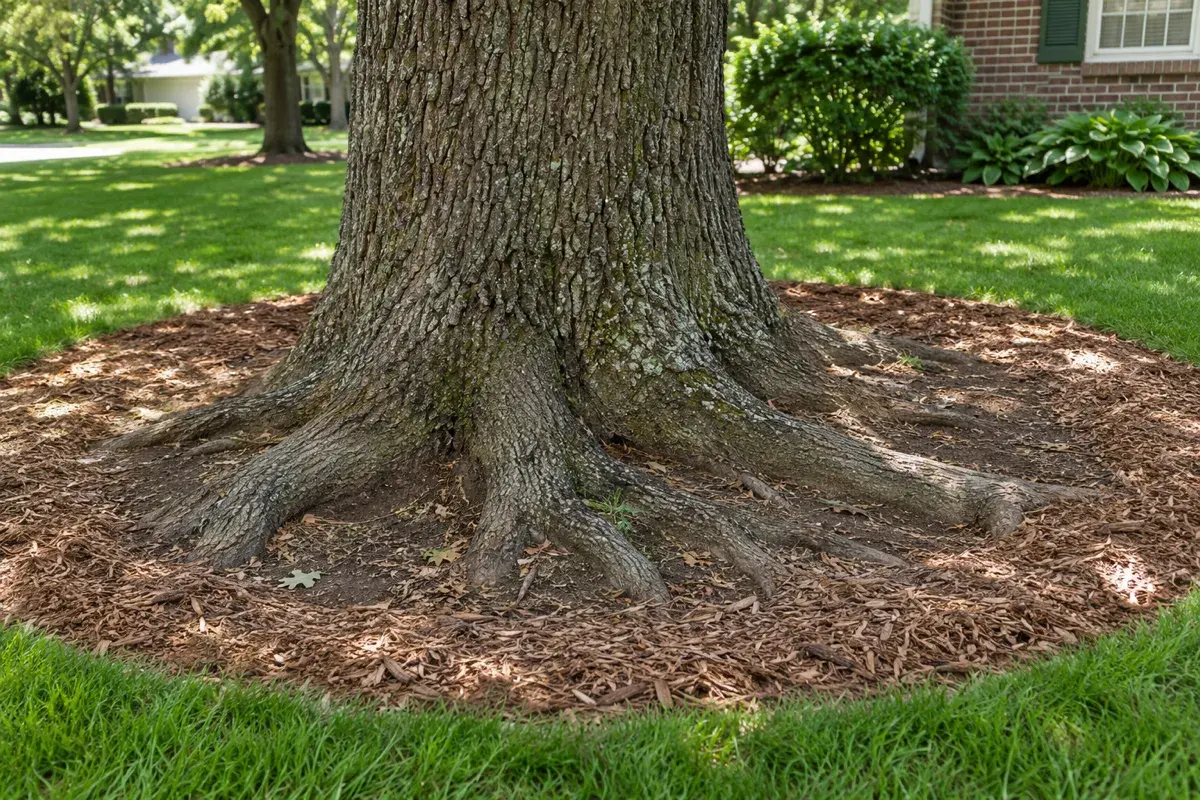
Surface roots and struggling grass don't, by themselves, justify removal. Iowa State Extension describes exposed roots as normal for many trees. Avoid cutting them or adding soil to hide them. Added soil can reduce oxygen available to roots and won't permanently solve the mowing problem.
Replace the troublesome lawn area with a broad, shallow organic mulch bed. Maryland Extension recommends 1–3 inches of mulch, kept about 3 inches away from the trunk. Include existing material when checking depth. Leave the root flare visible, and don't bury raised roots beneath a mound. Skip piled stones and raised soil rings around the trunk.
Fallen leaves can remain as mulch; shredded leaves settle more evenly. Keep the layer shallow and the trunk clear. Don't plant English ivy at the base of a tree you want to retain. Clemson documents how climbing ivy can cover and shade a tree's foliage.
If you'd like plants beneath the canopy, start with garden design for shade and avoid excavation through established roots. Have health or structural concerns assessed before removal. Check your survey and ownership documents for builder-planted trees rather than assuming the builder or HOA still maintains them after closing.
Surface roots are a reason to reconsider the lawn beneath a tree before considering removal.
FAQ
How far from the house should I plant a tree?
Start with half its expected mature crown width, then adjust for species, structures, and local conditions. A tree expected to spread 40 feet gives a starting distance of 20 feet from the foundation. Roots extend beyond crowns, so this doesn't establish clearance from septic systems or prove that a particular foundation is protected.
How many arborvitae do I need for a privacy screen?
Set the first and last trunk positions, divide the distance between them by the chosen spacing, round up the number of intervals, then add one plant. In a hypothetical layout with 48 feet between end trunks and 4-foot spacing, that's 12 intervals and 13 plants. Confirm the cultivar's spacing first; keep end plants far enough inside the bed for their mature spread.
Is it better to plant small or large trees?
Smaller stock is easier to handle and generally establishes sooner; larger stock gives immediate height but needs more establishment care. Minnesota Extension's guidance shows establishment time increasing with trunk size. Check root quality either way. ISA recommends exposing the root flare and keeping it visible after planting; excess nursery soil can hide it. A bigger tree planted too deeply is a poor trade.
When should I water a new hedge, and for how long?
Water at planting and check the root balls frequently. Minnesota Extension's starting schedule is daily for the first 1–2 weeks, every 2–3 days through week 12, then weekly until established. Adapt it to rainfall, soil moisture, species, and local advice; saturated soil needs drainage assessment rather than another automatic watering. Apply water slowly over the root ball and surrounding soil. Establishment can take several growing seasons, especially for larger stock. A lawn sprinkler cycle alone doesn't confirm that each root ball received enough water.